Sunflower Growth Stages and Life Cycle, From Seed to Harvest
Sunflower growth stages: the seed sprouts in 5–10 days, the stem shoots up while young plants track the sun, a bud forms at around 6–9 weeks, the flower opens at about 9–13 weeks, and the seeds are ripe 80–120 days after sowing.
Seed to sprout: germination
How a sunflower seed transforms into a visible sprout.
Germination timeline
- 1
Sow directly outdoors
Day 0
Sow 2.5–4 cm (1–1½ in) deep in a sunny spot after the last frost, once the soil is around 10°C (50°F) or warmer. Sunflowers grow a long taproot, so sowing them where they're going to flower works better than transplanting.
→ Seed sown
Read the steps as text
- Sow directly outdoors. Day 0 Sow 2.5–4 cm (1–1½ in) deep in a sunny spot after the last frost, once the soil is around 10°C (50°F) or warmer. Sunflowers grow a long taproot, so sowing them where they're going to flower works better than transplanting.
- The seed absorbs water. Day 1–3 The kernel inside the striped shell soaks up water and swells, splitting the shell along its seam.
- A hooked shoot breaks through. Day 4–7 The root pushes down first, then a hooked stem lifts the seed leaves through the soil — often still wearing the empty seed shell, which birds love to pull at.
- Seed leaves unfold. Day 5–10 Two thick, oval seed leaves open and turn green. Protect seedlings from slugs and birds for the first couple of weeks.
Seed to harvest: full life cycle
Every stage of a sunflower plant's life, from sowing to picking. It's drawn as a loop, the way a life cycle conventionally is — left to flower and go to seed instead of being harvested, a plant produces the seed for next year's crop.
Full life cycle timeline
- 1
Germination
Day 0–10
The seed sprouts in about a week — see the timeline above.
→ Sprout emerges
Read the steps as text
- Germination. Day 0–10 The seed sprouts in about a week — see the timeline above.
- First pairs of true leaves. Week 2–3 Rough, heart-shaped true leaves appear in pairs. From here the stem gains new leaves every few days.
- The stem shoots up. Week 3–7 Sunflowers grow remarkably fast in warm sun — tall varieties can gain several centimetres a day. Young plants track the sun: the top of the plant faces east in the morning and swings west through the day, then turns back east overnight.
- A flower bud appears. Week 6–9 A tight green bud, wrapped in pointed bracts, forms at the top of the stem and keeps tracking the sun while it enlarges.
- The flower head opens. Week 9–13 The yellow "petals" are really ray florets; the centre is hundreds to thousands of tiny disc florets that open in rings from the outside in over about 1–2 weeks. Once flowering, the head stops tracking the sun and usually faces east — warming it in the morning, which attracts more bees.
- Seeds fill and the head droops. Week 12–16 Each pollinated disc floret becomes a seed. The petals wither, the head grows heavy and starts to nod, and the back of the head turns from green to yellow, then brown.
- Ready to harvest seeds. 80–120 days from sowing When the back of the head is yellow-brown and the seeds are plump and loosen easily, cut the head with about 30 cm (1 ft) of stem and hang it somewhere dry and airy to finish. Cover heads with a paper bag or netting near the end if birds are getting there first.
Sunflower growth stages infographic
Every stage on one page — free to save, print for the garden shed or classroom, or pin.
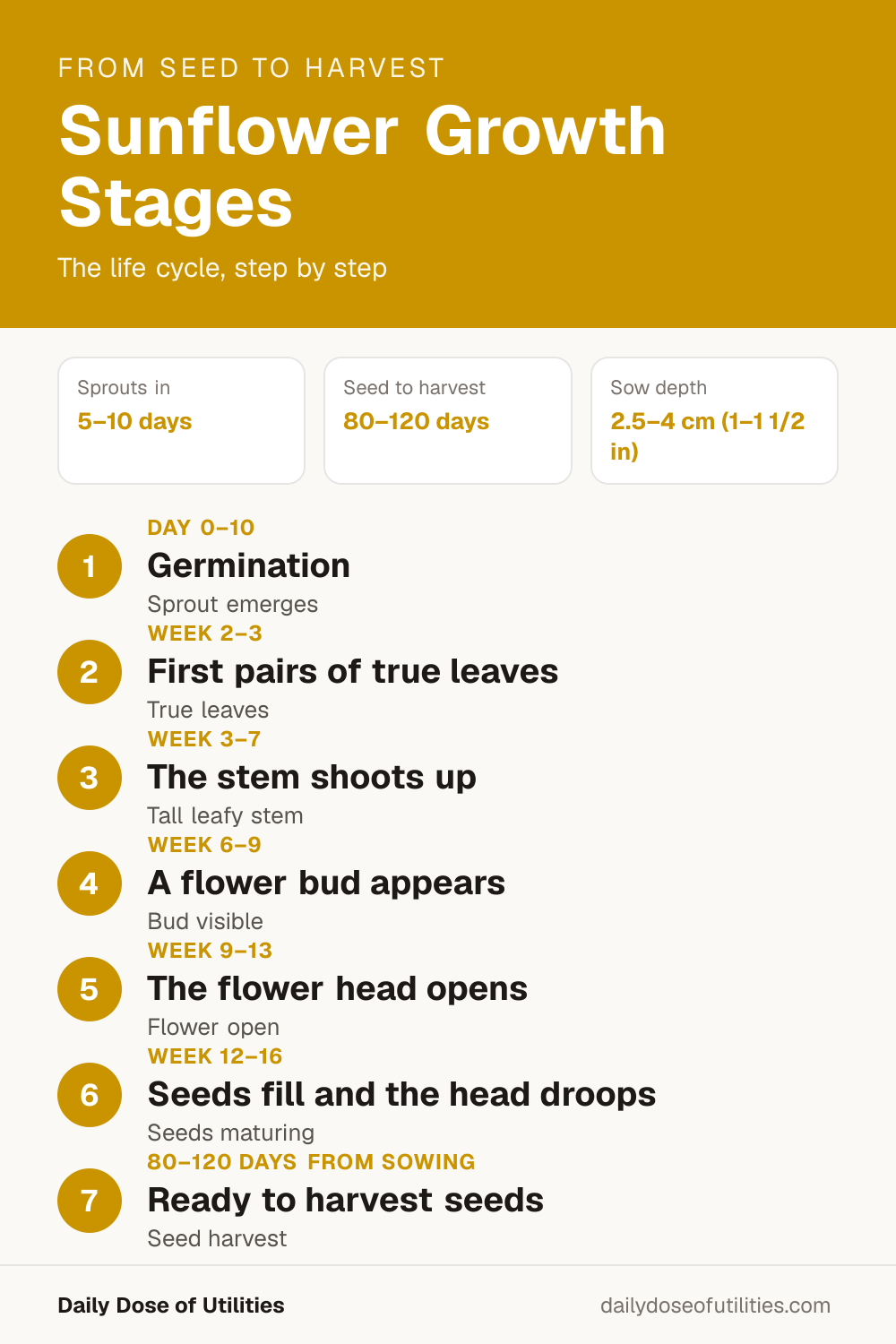
The sunflower life cycle at a glance
Germination (days 0–10): the seed splits its striped shell and sends up a hooked shoot with two oval seed leaves.
Seedling (weeks 2–3): rough, heart-shaped true leaves appear in pairs.
Rapid growth (weeks 3–7): the stem shoots up, and the young plant follows the sun across the sky each day.
Bud (weeks 6–9): a green bud wrapped in pointed bracts forms at the top.
Flowering (weeks 9–13): the head opens, with yellow ray florets around a centre of hundreds or thousands of tiny disc florets.
Seed (weeks 12–16 and harvest at 80–120 days): pollinated florets become seeds, the head droops, and the seeds ripen — ready to eat, feed birds or sow next year.
Do sunflowers follow the sun?
Young sunflowers do. Before they flower, the top of the plant turns from east to west during the day and swings back east overnight, because the stem grows a little faster on one side than the other in rhythm with the plant's internal clock. This helps it catch more light while it's growing fast.
Once the flower opens, the stem stops elongating and the head settles facing east. Research has shown east-facing heads warm up faster in the morning and attract more pollinating bees than heads turned west.
One flower, or thousands?
A sunflower head is really a cluster of many small flowers. The yellow "petals" around the edge are ray florets, which attract pollinators but don't make seeds. The centre is packed with disc florets, arranged in interlocking spirals; each one that's pollinated becomes a single seed.
The disc florets open in rings from the outside in over one to two weeks, which is why a flowering head often shows a band of pollen-covered florets moving towards the centre.
Frequently asked questions
- How long do sunflower seeds take to germinate?
- About 5–10 days in soil around 10°C (50°F) or warmer — often just 5–7 days in warm late-spring soil.
- How long do sunflowers take to grow?
- Most varieties flower about 60–90 days after sowing, and the seeds are ripe for harvest at around 80–120 days, depending on the variety.
- What are the stages of a sunflower's life cycle?
- Seed, germination, seedling, rapid vegetative growth, bud, flowering, and seed development — after which the ripe seeds can start the cycle again. Sunflowers are annuals that complete the whole cycle in one season.
- Do sunflowers really follow the sun?
- Young plants do, turning east to west each day before they flower. Mature flower heads stop moving and mostly face east.
- When are sunflower seeds ready to harvest?
- When the back of the head has turned from green to yellow-brown, the petals have dried and the seeds are plump and come loose easily.