Pumpkin Growth Stages and Life Cycle, From Seed to Harvest
Pumpkin growth stages: the seed sprouts in 5–10 days, vines spread over weeks 3–8, male then female flowers open at around 7–10 weeks, and the fruit swells, turns colour and hardens until it's ready to cut 90–120 days after sowing.
Seed to sprout: germination
How a pumpkin seed transforms into a visible sprout.
Germination timeline
- 1
Sow in warm soil
Day 0
Sow 2.5 cm (1 in) deep outdoors after the last frost, once the soil is at least 16°C (60°F) — or indoors in individual pots 2–3 weeks earlier, since pumpkins dislike root disturbance. For a Halloween harvest, sow about 3–4 months beforehand, in late spring to early summer.
→ Seed in warm soil
Read the steps as text
- Sow in warm soil. Day 0 Sow 2.5 cm (1 in) deep outdoors after the last frost, once the soil is at least 16°C (60°F) — or indoors in individual pots 2–3 weeks earlier, since pumpkins dislike root disturbance. For a Halloween harvest, sow about 3–4 months beforehand, in late spring to early summer.
- The seed absorbs water. Day 1–2 The large, flat seed soaks up water and swells. Its big food store lets the seedling grow fast once it starts — but in cold, wet soil it tends to rot instead.
- A thick hooked shoot breaks through. Day 4–7 The root anchors first, then a sturdy hooked stem pushes up through the soil, often lifting the empty seed coat with it.
- Two big seed leaves unfold. Day 5–10 Two large, smooth, oval seed leaves open — almost identical to zucchini and other squash seedlings, which are the same plant family.
Seed to harvest: full life cycle
Every stage of a pumpkin plant's life, from sowing to picking. It's drawn as a loop, the way a life cycle conventionally is — left to flower and go to seed instead of being harvested, a plant produces the seed for next year's crop.
Full life cycle timeline
- 1
Germination
Day 0–10
Quick in warm soil — see the timeline above.
→ Sprout emerges
Read the steps as text
- Germination. Day 0–10 Quick in warm soil — see the timeline above.
- First true leaves. Week 2–3 Large, rough, lobed true leaves appear. The young plant puts most of its energy into roots and leaves from here.
- Long vines spread. Week 3–8 Vines run out in every direction — often 3–6 m (10–20 ft) for full-size pumpkins — rooting at the leaf joints where they touch moist soil. Give them plenty of room or train them along the edge of the bed.
- Male, then female flowers. Week 7–10 Large yellow flowers open for a single morning. Male flowers usually come first, followed about a week or two later by female flowers with a tiny pumpkin behind the petals. Bees carry pollen between them; poorly pollinated fruit often drops off.
- Fruit swells. Week 9–14 A pollinated pumpkin grows quickly, starting green on most orange varieties. Consistent watering matters most now; slip a board or straw under the fruit to keep it off damp soil.
- Colour deepens and the rind hardens. Week 13–17 The skin turns its full colour and the rind hardens until a fingernail won't easily dent it. The stem above the fruit starts to dry and turn corky.
- Ready to cut. 90–120 days from sowing Cut the stem with pruners, leaving 5–10 cm (2–4 in) attached — a pumpkin without its stem rots quickly. Harvest before a hard frost, then cure in a warm, dry spot for about 10 days to toughen the skin for storage.
Pumpkin growth stages infographic
Every stage on one page — free to save, print for the garden shed or classroom, or pin.
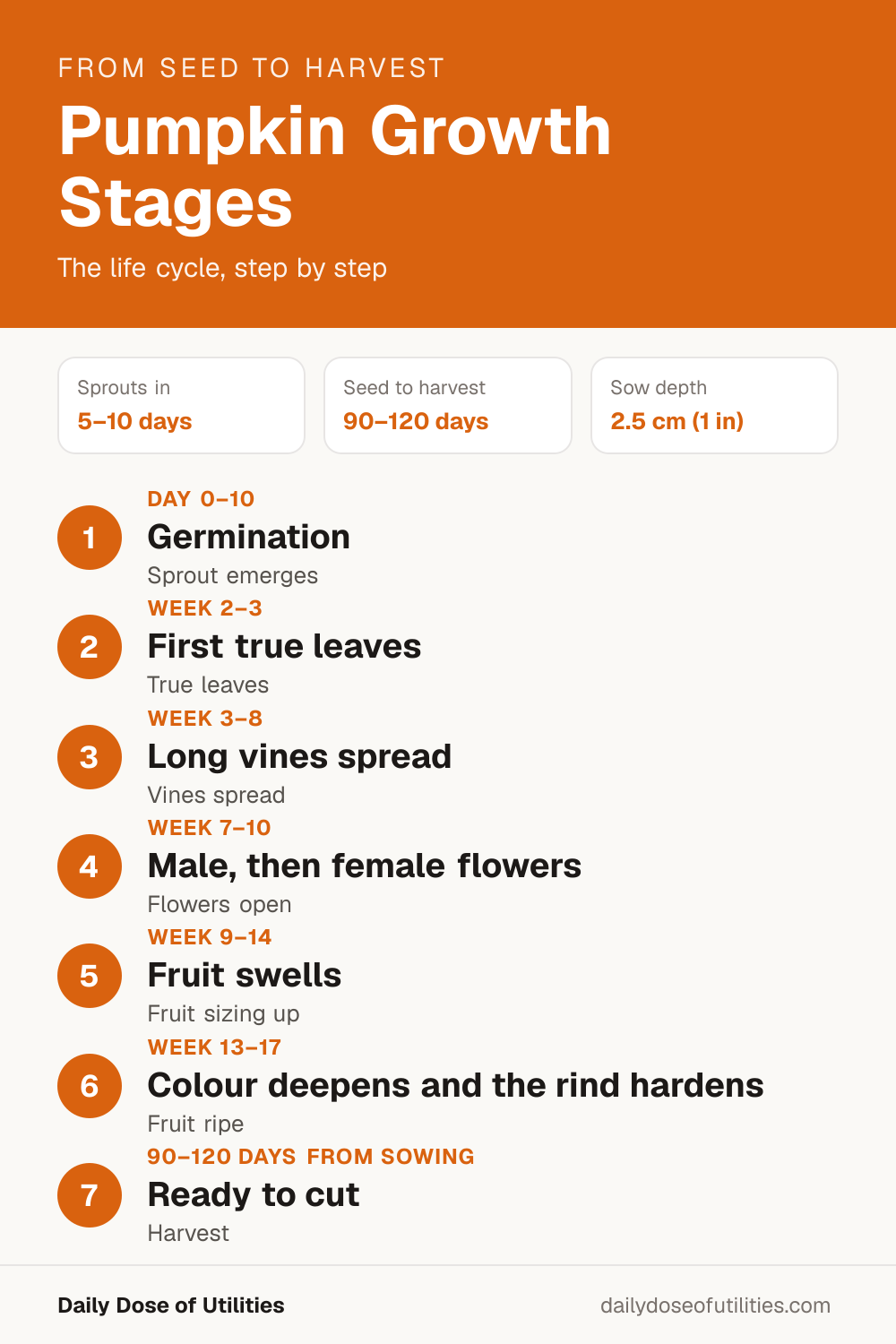
The pumpkin life cycle at a glance
Seed and germination (days 0–10): the flat seed sprouts in warm soil and opens two large oval seed leaves.
Seedling (weeks 2–3): rough, lobed true leaves appear.
Vines (weeks 3–8): long vines spread across the ground, often 3–6 m (10–20 ft) for big varieties.
Flowers (weeks 7–10): male flowers open first, then female flowers with a tiny pumpkin at their base; bees pollinate them.
Fruit (weeks 9–17): the pumpkin swells, usually starting green, then turns its full colour and hardens.
Harvest (90–120 days): cut it with a length of stem attached once the rind is hard — and inside are the seeds that start the cycle again.
When to plant pumpkins for Halloween
Count back from the end of October using the days to maturity on the seed packet: most carving pumpkins need about 90–120 days, so they're sown from late May to early July in much of the Northern Hemisphere. Sow too early and the fruit ripens in August and may soften before Halloween; too late and a frost can arrive first.
A ripe pumpkin keeps well. Once cut and cured in a warm, dry place for about 10 days, an uncarved pumpkin often lasts two to three months somewhere cool and dry.
Why pumpkins need bees
Each pumpkin flower is either male or female and opens for only one morning. Pollen has to travel from a male flower to a female one, and a single female flower needs many bee visits for a big, well-shaped fruit. Small pumpkins that turn yellow and drop off were usually not pollinated well.
If bees are scarce, pollinate by hand early in the morning: pick an open male flower, peel back its petals and brush its pollen onto the centre of an open female flower.
Frequently asked questions
- How long do pumpkin seeds take to germinate?
- About 5–10 days in soil at least 16°C (60°F); faster in warmer soil. In cold, wet soil the seed often rots instead.
- How long does it take to grow a pumpkin?
- Most varieties take about 90–120 days from sowing to a ripe pumpkin; small pie pumpkins can be quicker and giant varieties slower.
- What are the stages of a pumpkin's life cycle?
- Seed, sprout, seedling with true leaves, vine, flower (male and female), green pumpkin, and ripe pumpkin — whose seeds grow into the next generation.
- Why are my pumpkin flowers falling off?
- Early on, these are male flowers, which naturally drop after a day. If female flowers (with a tiny pumpkin behind them) shrivel, they weren't pollinated — encourage bees or hand-pollinate.
- How do I know when a pumpkin is ripe?
- The skin has reached its full colour, the rind resists a fingernail, the stem has started to dry and harden, and it sounds hollow when tapped.