Pea Growth Stages and Life Cycle, From Seed to Harvest
Pea growth stages: the seed sprouts in 7–14 days in cool soil, tendrils start climbing at 2–5 weeks, flowers open at around 5–7 weeks, and pods are ready to pick about three weeks later — 55–70 days after sowing.
Seed to sprout: germination
How a pea seed transforms into a visible sprout.
Germination timeline
- 1
Sow the seed
Day 0
Sow directly outdoors 2.5–5 cm (1–2 in) deep in early spring, as soon as the soil can be worked — peas are a cool-season crop and germinate in soil as cool as about 5°C (40°F), though slowly.
→ Seed in cool soil
Read the steps as text
- Sow the seed. Day 0 Sow directly outdoors 2.5–5 cm (1–2 in) deep in early spring, as soon as the soil can be worked — peas are a cool-season crop and germinate in soil as cool as about 5°C (40°F), though slowly.
- The seed takes up water. Day 1–3 The dry, often wrinkled seed absorbs water and plumps up. Wrinkled-seeded varieties (most sweet garden peas) are more likely to rot in cold, wet soil than smooth-seeded ones, which are hardier for very early sowing.
- The shoot pushes up. Day 7–14 Unlike beans, peas leave their seed halves underground: only the shoot grows upward, so the plant can regrow from below if a late frost or a bird nips the tip. Warmer soil means faster emergence — around a week at 15–20°C (60–70°F), two or more in cold soil.
- First leaves unfold. Day 10–18 Small scale-like leaves come first, followed by the first proper leaves with paired leaflets.
Seed to harvest: full life cycle
Every stage of a pea plant's life, from sowing to picking. It's drawn as a loop, the way a life cycle conventionally is — left to flower and go to seed instead of being harvested, a plant produces the seed for next year's crop.
Full life cycle timeline
- 1
Germination
Day 0–18
The shoot comes up while the seed halves stay underground — see the timeline above.
→ Sprout emerges
Read the steps as text
- Germination. Day 0–18 The shoot comes up while the seed halves stay underground — see the timeline above.
- Tendrils reach for support. Week 2–5 The tips of the leaves turn into curling tendrils that wrap around anything thin — netting, twine or twiggy sticks. Give support early; even short varieties crop better held off the ground. Root nodules fix nitrogen from the air, as in beans.
- Vines lengthen. Week 4–6 Dwarf varieties reach about 45–75 cm (18–30 in); tall varieties can climb past 1.8 m (6 ft). Peas grow best in cool weather, around 13–21°C (55–70°F).
- Flowers open. Week 5–7 White or purple flowers open from the lower part of the vine upward. Peas pollinate themselves, usually before the flower even opens, so no insects are needed — but hot weather above about 27°C (80°F) cuts flowering short.
- Pods swell. Week 7–10 Pods form behind the faded flowers and fill out over about three weeks. Snow peas are picked flat, snap peas when the pod is plump but still crisp, and shelling peas when the peas inside are round but still bright green.
- Ready to pick. 55–70 days from sowing Pick every couple of days — peas turn starchy fast once mature. Production stops when summer heat arrives, which is why peas are sown again in late summer for an autumn crop in many climates.
Pea growth stages infographic
Every stage on one page — free to save, print for the garden shed or classroom, or pin.
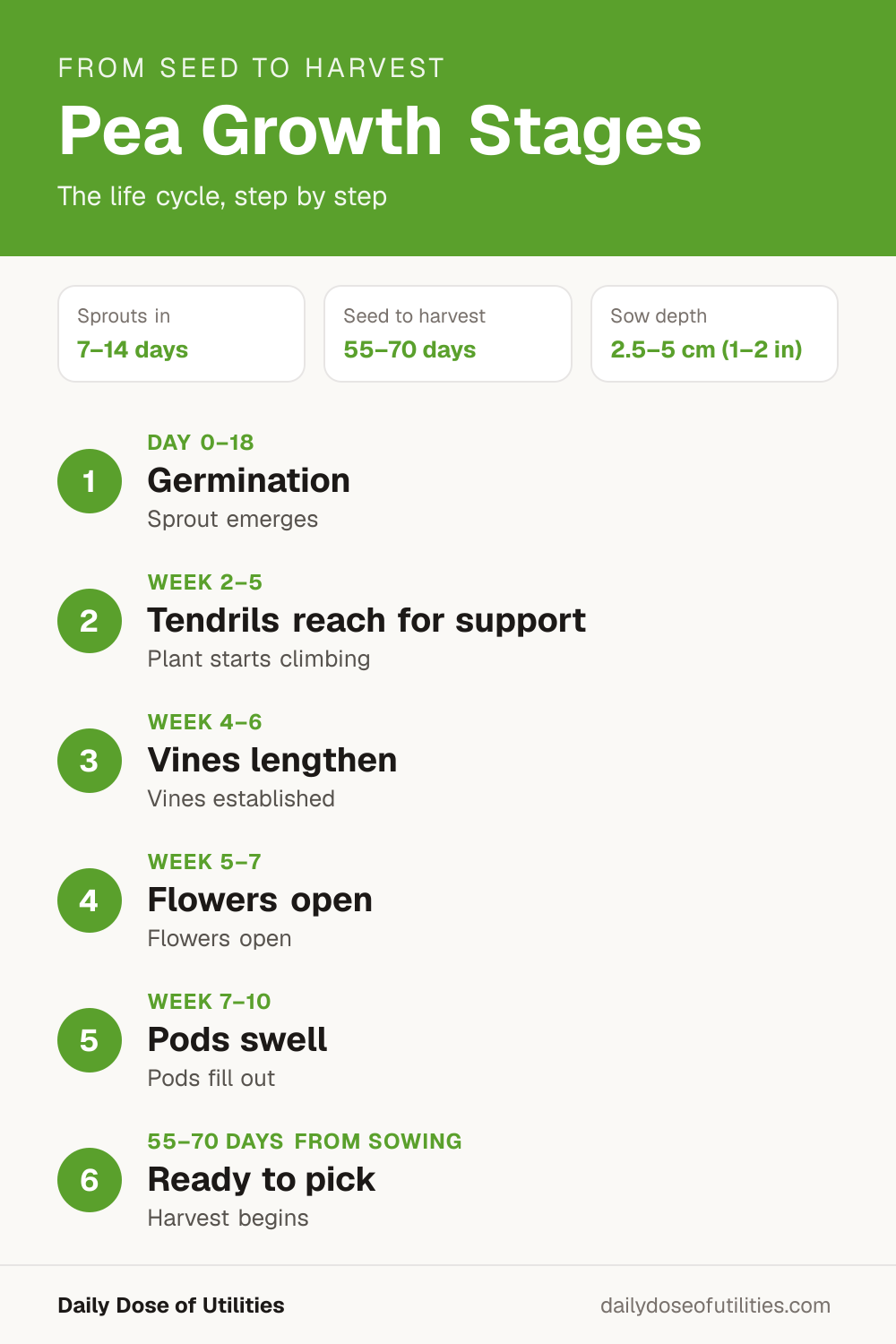
Pea plant growth stages at a glance
Germination (days 0–18): the seed swells and sends up a shoot in 7–14 days, leaving its seed halves underground.
Seedling and tendrils (weeks 2–5): leaves with paired leaflets appear, and their tips turn into tendrils that grab any support.
Vine growth (weeks 4–6): vines lengthen — about 45–75 cm (18–30 in) for dwarf varieties, much taller for climbing ones.
Flowering (weeks 5–7): white or purple flowers open from the bottom of the vine upward and pollinate themselves.
Pods and harvest (weeks 7–10): pods fill out over about three weeks and are ready 55–70 days from sowing.
A cool-season crop
Peas grow best between about 13 and 21°C (55–70°F) and tolerate light frost, so they're sown as early in spring as the soil can be worked — often a month or more before the last frost. Summer heat above about 27°C (80°F) ends flowering, so a late sowing for an autumn crop works well in many climates.
Because peas leave their seed halves underground (hypogeal germination), a seedling nipped by frost or a bird can regrow from buds below the surface — one reason they cope with early sowing.
The full pea life cycle — and Mendel's peas
Peas are annuals. Pods left on the vine swell, then dry to a papery tan with hard, wrinkled or smooth seeds inside — next year's seed peas. Like beans, peas host nitrogen-fixing bacteria in root nodules, so they leave the soil richer for the next crop.
Because pea flowers pollinate themselves before they open, each plant's traits are passed on predictably — which is exactly why Gregor Mendel used garden peas in the 1860s to work out the basic rules of inheritance.
Frequently asked questions
- How long do peas take to germinate?
- About 7–14 days. They sprout faster in soil around 15–20°C (60–70°F) and more slowly in cold early-spring soil, but will still germinate at around 5°C (40°F).
- How long do peas take to grow from seed to harvest?
- About 55–70 days for most varieties, depending on the type and the weather.
- Do peas need something to climb?
- Yes — even dwarf varieties do better with short twiggy sticks or netting. Their tendrils wrap around thin supports; climbing varieties need netting about 1.8 m (6 ft) tall, or taller for the tallest types.
- Why have my peas stopped producing?
- Usually summer heat: above about 27°C (80°F) flowering stops. Leaving mature pods on the vine also signals the plant to stop, so keep picking.
- When do you pick snow, snap and shelling peas?
- Snow peas while the pod is still flat; snap peas when the pod is plump but crisp; shelling peas when the peas are round and the pod is bright green, before it turns pale or waxy.