Lettuce Growth Stages and Life Cycle, From Seed to Harvest
Lettuce growth stages: the seed sprouts in 2–10 days, baby leaves are ready in about 25–30 days, leaf lettuce reaches full size in 45–55 days and heading types in 55–80 days, before heat makes the plant bolt, flower and set seed.
Seed to sprout: germination
How a lettuce seed transforms into a visible sprout.
Germination timeline
- 1
Sow very shallow
Day 0
Sow just 3–6 mm (⅛–¼ in) deep or press seed onto the surface — many lettuce varieties need light to germinate. Lettuce is a cool-season crop: it germinates best around 15–20°C (60–68°F), and above about 27°C (80°F) many seeds stay dormant.
→ Seed sown shallow
Read the steps as text
- Sow very shallow. Day 0 Sow just 3–6 mm (⅛–¼ in) deep or press seed onto the surface — many lettuce varieties need light to germinate. Lettuce is a cool-season crop: it germinates best around 15–20°C (60–68°F), and above about 27°C (80°F) many seeds stay dormant.
- The seed absorbs water. Day 1 The tiny seed takes up water within hours. The surface must stay moist, since seed sown this shallow dries out quickly.
- Root and shoot emerge. Day 2–5 In cool, moist soil lettuce sprouts fast — often in 2–3 days, and usually within a week. A tiny white root anchors first, then the shoot lifts the seed leaves.
- Seed leaves unfold. Day 4–10 Two small, rounded, spoon-shaped seed leaves open. They look the same for every variety — the differences only show with the true leaves.
Seed to harvest: full life cycle
Every stage of a lettuce plant's life, from sowing to picking. It's drawn as a loop, the way a life cycle conventionally is — left to flower and go to seed instead of being harvested, a plant produces the seed for next year's crop.
Full life cycle timeline
- 1
Germination
Day 0–10
Fast in cool weather, slow or stalled in heat — see the timeline above.
→ Sprout emerges
Read the steps as text
- Germination. Day 0–10 Fast in cool weather, slow or stalled in heat — see the timeline above.
- First true leaves. Week 2–3 True leaves with the variety's shape and colour appear. Thin seedlings now — about 15–20 cm (6–8 in) apart for leaf types, 25–30 cm (10–12 in) for heading types.
- A loose rosette of leaves. Week 3–6 Leaves spread out from a short central stem in a rosette. Leaf lettuce is ready to pick as "baby leaves" from about 25–30 days.
- Full leaves or a firm head. Week 6–10 Leaf types reach full size; butterhead, romaine (cos) and crisphead (iceberg) types fold their inner leaves into a head. Steady moisture keeps leaves sweet and tender.
- Ready to harvest. 45–55 days (leaf), 55–80+ days (heading) Pick outer leaves as needed ("cut and come again") or cut the whole head just above the soil. Harvest in the cool of the morning for the crispest leaves.
- Bolting, flowers and seed. After harvest window Heat and long days trigger bolting: the centre stretches into a tall stalk, the leaves turn bitter, and small yellow flowers open. About two weeks later they become fluffy, dandelion-like seed heads — the seed for the next generation.
Lettuce growth stages infographic
Every stage on one page — free to save, print for the garden shed or classroom, or pin.
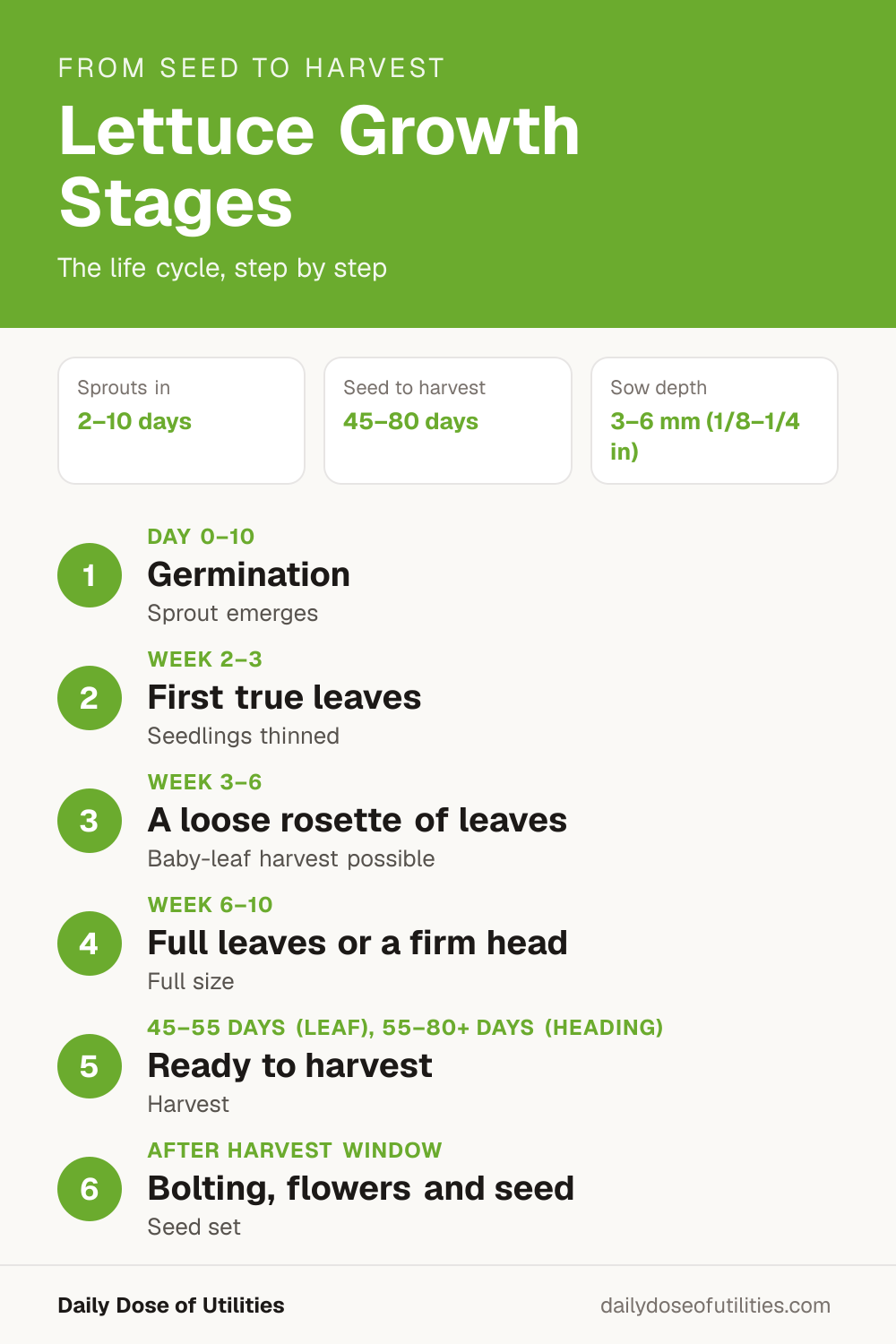
Lettuce growth stages at a glance
Germination (days 0–10): the tiny seed sprouts in 2–3 days in cool soil and opens two small, spoon-shaped seed leaves.
Seedling (weeks 2–3): the first true leaves show the variety's shape and colour — time to thin.
Rosette (weeks 3–6): leaves spread from a short central stem; baby leaves can be picked from about 25–30 days.
Full size or heading (weeks 6–10): leaf types reach full size, and butterhead, romaine and iceberg types fold into heads.
Bolting and seed (after harvest): heat and long days push up a flower stalk, small yellow flowers and fluffy seed heads.
Why lettuce sometimes won't sprout
Many lettuce varieties need light to germinate, so seed buried too deep may simply stay dormant — sow it on the surface or barely cover it. Lettuce is also one of the few crops that can be too warm to sprout: above about 27°C (80°F) soil, many seeds go dormant (thermodormancy).
In summer, sow in the evening, water with cool water, or start seed indoors and transplant — a few degrees of cooling is often all it takes.
Bolting: the end of the lettuce life cycle
Lettuce is an annual that's harvested long before it completes its life cycle. When days lengthen and temperatures climb, the plant bolts: the central stem shoots up, milky sap makes the leaves bitter, and branching stalks of small yellow, daisy-like flowers open.
About two weeks after flowering, each flower head turns into a fluffy seed head like a small dandelion clock. Those seeds are next year's crop — which is why gardeners save seed from the latest-bolting plants, slowly selecting for lettuce that stays sweet longer.
Frequently asked questions
- How long does lettuce take to germinate?
- Often just 2–3 days in cool, moist soil, and usually within 7–10 days. In soil above about 27°C (80°F), many seeds won't germinate at all.
- How long does lettuce take to grow?
- About 25–30 days for baby leaves, 45–55 days for full-size leaf lettuce, and 55–80 days or more for heading types like butterhead, romaine and iceberg.
- Should lettuce seeds be covered?
- Only very lightly, 3–6 mm (⅛–¼ in) at most. Many varieties need light to germinate, so press the seed into the surface or dust it with fine soil.
- What does it mean when lettuce bolts?
- The plant has switched to flowering: the centre stretches into a tall stalk and the leaves turn bitter. It's triggered by heat and long days, so sow in spring and autumn, or choose slow-bolting varieties for summer.
- Will lettuce grow back after cutting?
- Leaf lettuce will: pick outer leaves, or cut the plant about 2.5 cm (1 in) above the soil, and it regrows for several more harvests. Heading types are usually cut once.