Corn Growth Stages and Life Cycle, From Seed to Harvest
Corn growth stages: the kernel sprouts in 7–10 days, the plant adds leaves and grows fast for about two months, tassels shed pollen at around 7–10 weeks, silks catch it a few days later, and sweet corn is ready about three weeks after silking — 70–100 days from sowing.
Seed to sprout: germination
How a corn seed transforms into a visible sprout.
Germination timeline
- 1
Sow in warm soil, in blocks
Day 0
Sow 2.5–5 cm (1–2 in) deep after the last frost, once the soil is at least 10°C (50°F) — 16°C (60°F) or warmer for supersweet varieties. Plant in a block of short rows rather than one long row, so the wind-blown pollen reaches every plant.
→ Seed sown in a block
Read the steps as text
- Sow in warm soil, in blocks. Day 0 Sow 2.5–5 cm (1–2 in) deep after the last frost, once the soil is at least 10°C (50°F) — 16°C (60°F) or warmer for supersweet varieties. Plant in a block of short rows rather than one long row, so the wind-blown pollen reaches every plant.
- The kernel absorbs water. Day 1–3 The dry kernel soaks up water and swells. In cold, wet soil it often rots before sprouting, which is why waiting for warm soil pays off.
- A pointed shoot spikes up. Day 5–10 The root grows down, then a pointed, sheathed shoot (the coleoptile) pushes straight up through the soil. Like other grasses, corn leaves its seed — and its growing point — below ground for the first few weeks.
- The first leaf unrolls. Day 7–10 The first grass-like leaf unrolls from the spike, followed by more, each one emerging from the one before.
Seed to harvest: full life cycle
Every stage of a corn plant's life, from sowing to picking. It's drawn as a loop, the way a life cycle conventionally is — left to flower and go to seed instead of being harvested, a plant produces the seed for next year's crop.
Full life cycle timeline
- 1
Germination
Day 0–10
A pointed shoot spikes up in about a week — see the timeline above.
→ Sprout emerges
Read the steps as text
- Germination. Day 0–10 A pointed shoot spikes up in about a week — see the timeline above.
- New leaves every few days. Week 2–5 Growers count corn's growth in leaves (V1, V2, V3…). Brace roots start growing from the lower stem joints to anchor the plant as it gets taller.
- Rapid stalk growth. Week 5–8 The stalk shoots up quickly in hot weather. Corn is a heavy feeder; a side-dressing of nitrogen around knee height helps, and watering matters most from here to harvest.
- Tassels shed pollen. Week 7–10 The tassel at the top of the plant is the male flower. It sheds pollen for about a week, which drifts down on the wind onto the silks below.
- Silks emerge from the young ears. A few days after tassels Silks are the female flowers' long styles — each silk leads to one kernel on the cob. A silk must catch a pollen grain for its kernel to develop, which is why cobs from a single long row often have gaps.
- Kernels fill with sweet milk. About 3 weeks after silking Kernels swell with sugary, milky juice. The silks turn brown and dry while the husks stay green — the sign that sweet corn is nearly ready.
- Ready to pick. 70–100 days from sowing Pick when a kernel pressed with a thumbnail squirts milky juice. Sugar starts turning to starch soon after picking, so eat or chill sweet corn quickly. Left on the stalk, kernels dry and harden into next year's seed.
Corn growth stages infographic
Every stage on one page — free to save, print for the garden shed or classroom, or pin.
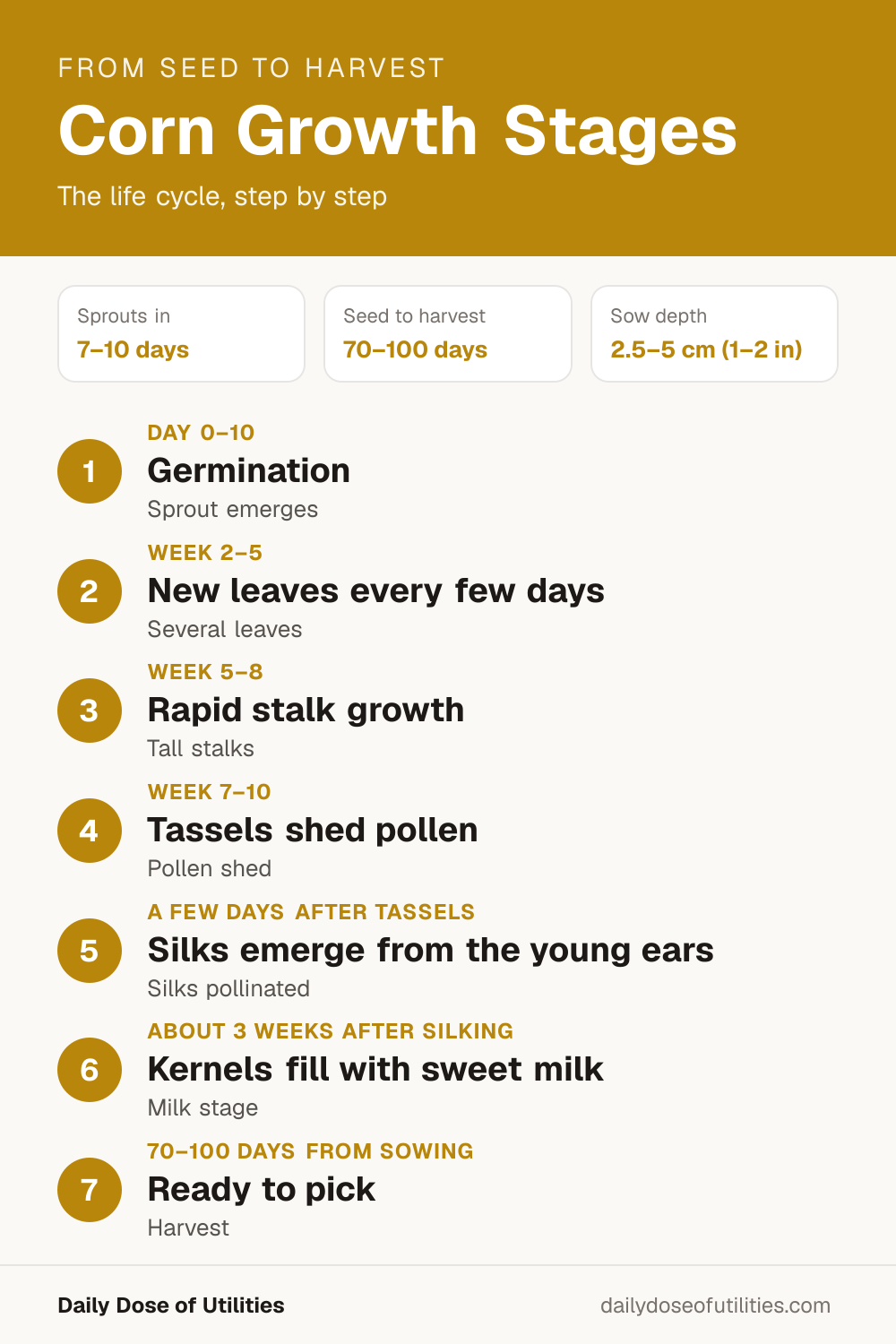
Corn plant growth stages at a glance
Germination (days 0–10): a pointed shoot spikes up through the soil and the first leaf unrolls.
Leaf stages (weeks 2–5): new leaves appear every few days; growers number them V1, V2, V3 and so on.
Rapid growth (weeks 5–8): the stalk shoots up and brace roots anchor it.
Tasselling (weeks 7–10): the tassel at the top sheds pollen for about a week.
Silking (a few days after tassels): silks emerge from the young ears and catch the falling pollen.
Kernel fill and harvest (about 3 weeks after silking; 70–100 days from sowing): kernels fill with milky, sugary juice and are ready to pick.
Tassels, silks and why corn is planted in blocks
Corn is wind-pollinated. The tassel is the male flower; the silks are the female flowers, and every silk is connected to one potential kernel. For a full cob, pollen has to land on every silk.
In a single long row, much of the pollen blows away from the silks, leaving cobs with missing kernels. A block of at least four short rows puts plenty of pollen within reach of every ear. Keep different types — sweet, supersweet and popcorn — apart, as cross-pollination can make sweet corn starchy.
The full corn life cycle
Corn is an annual grass. Sweet corn is picked at the milk stage, while the kernels are still soft and sugary. Left on the plant, the kernels pass through a dough stage, then dent or harden and dry — each one becoming a seed for next year, completing the cycle.
That same mature, dry stage is how field corn and popcorn are harvested. Sweet corn varieties have extra sugar genes, which is why their dry seeds look shrivelled and why they need warmer soil to germinate.
Frequently asked questions
- How long does corn take to germinate?
- About 7–10 days in soil at 16°C (60°F) or warmer; it can take two weeks or more in cooler soil, and seed often rots below about 10°C (50°F).
- How long does sweet corn take to grow?
- About 70–100 days from sowing, depending on the variety, with the cobs ready roughly three weeks after the silks appear.
- What are the stages of corn growth?
- Germination, leaf (vegetative) stages, rapid growth, tasselling, silking, kernel fill (milk, then dough) and maturity — when the dry kernels are seeds for the next crop.
- Why does my corn have missing kernels?
- Poor pollination: each kernel needs pollen to land on its own silk. Plant in blocks rather than single rows, and avoid letting plants dry out while tassels and silks are out.
- How do I know when sweet corn is ready?
- The silks have turned brown and dry, the cob feels full, and a kernel pressed with a thumbnail squirts milky juice. Clear juice means it needs longer; paste means it's past its best.